
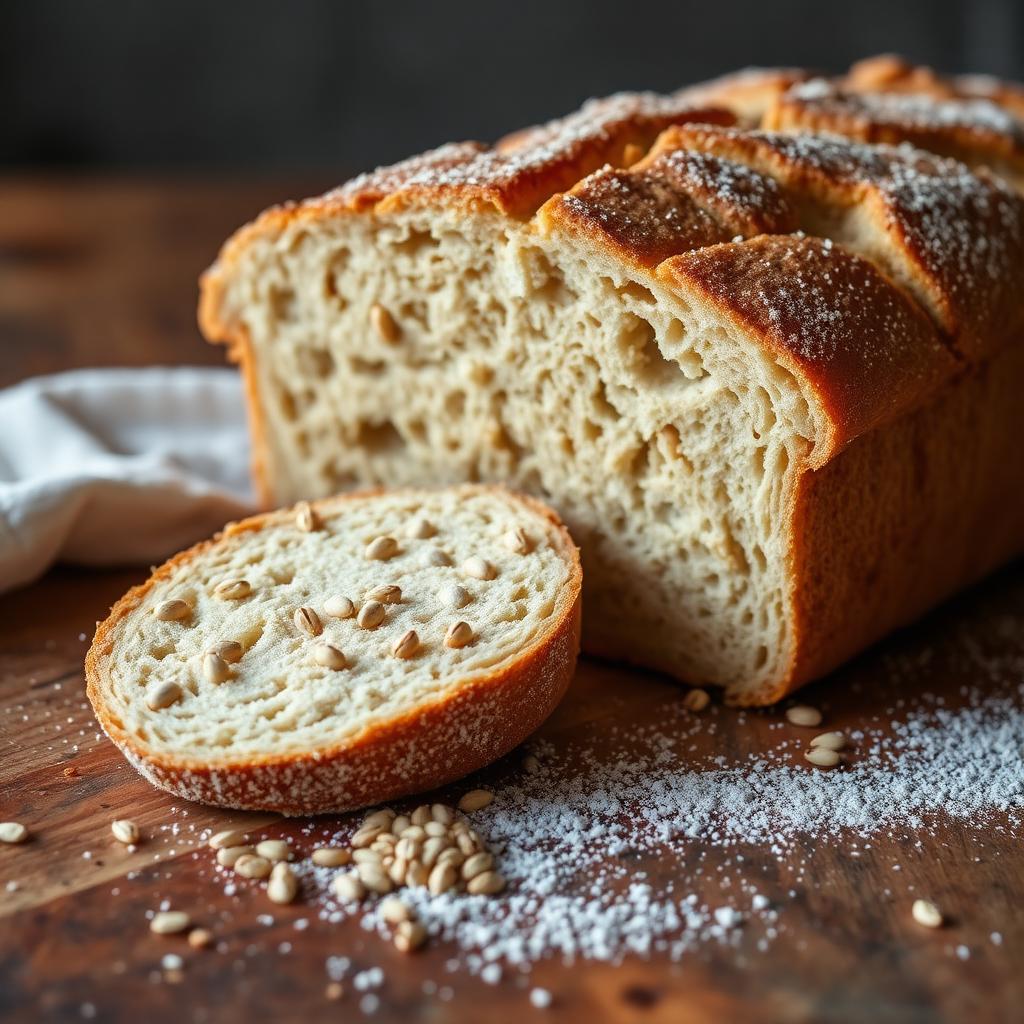
Introduction: the structural challenge of a gluten-free world
Producing gluten-free bread that matches traditional products in texture, elasticity, volume and shelf life has for years been the biggest challenge for food technologists. Gluten acts as the dough’s natural “structural skeleton” – it retains gases during fermentation and gives the crumb its desired springiness.
Among the available hydrocolloids, Psyllium Husk (Plantago ovata) emerges as the most effective and most natural functional substitute for gluten.
Mechanism of action: a mucilage that builds structure
The key property of psyllium husk is its extreme water-binding capacity. It consists of roughly 70% soluble fibre, which forms a thick, sticky mucilage on contact with moisture.
From a technological standpoint, this mechanism provides:
- Stabilisation of the starch matrix – the mucilage surrounds starch granules, forming a network similar to the gluten network.
- High dough viscosity and elasticity – enabling shaping and forming.
- Effective gas retention – CO₂ bubbles stay inside the dough, increasing bread volume.
Recommended dosage and practical implementation
A typical dose is 4–8% relative to the weight of gluten-free flour (most commonly 5–6% for yeasted breads). In studies, even 17% gave excellent results in terms of structure and freshness.
- Hydration: increase by 10–20% versus a standard recipe due to strong water binding.
- Order of addition: it is best to prepare the psyllium gel separately (soak for 5–10 min), then add it to the rest of the ingredients.
Challenges and solutions
- Excessive stickiness → adjust hydration and mixing time.
- Slight bitter aftertaste at high doses → combine with neutral-tasting flours (rice, corn) or mask with natural flavourings.
- Whole husk vs powder: whole husk – better elasticity; powder – stronger binding (use around 85–90% of the mass).
Hydrocolloid comparison
| Hydrocolloid | Typical dose | Clean Label | Texture | Shelf life | Cost | Notes |
|---|---|---|---|---|---|---|
| Psyllium Husk | 5–8% | Yes | Very good (springy) | Very good | Low–medium | Natural, high fibre content |
| HPMC | 2–4% | No | Good | Good | Medium–high | Synthetic |
| Xanthan gum | 0.5–1.5% | Yes | Medium | Medium | Medium | Can give a gummy texture |
| Guar gum | 0.5–2% | Yes | Medium | Medium | Low | Weaker gas retention |
Operational and quality benefits
- Better crumb texture – less crumbliness, higher springiness.
- Extended freshness – delays starch retrogradation by as much as 65–75% (acceptable quality up to 72h).
- Cost optimisation – reduction or elimination of synthetic additives.
- Versatility – breads, rolls, pizza, pastries.
Clean Label and health profile
Psyllium husk fits perfectly into the Clean Label trend – a 100% natural ingredient with no E-numbers.
- Extremely high soluble fibre content (supports digestion).
- Low glycaemic index – suitable for diabetics.
- Prebiotic effect – benefits the gut microbiota.
Sample base recipe (gluten-free bread per 500 g flour)
- Gluten-free flour (blend) – 500 g
- Psyllium Husk (whole) – 25–35 g (5–7%)
- Water (total) – 550–650 g (including for the psyllium gel)
- Instant yeast – 7–10 g
- Salt – 8–10 g
- Oil / olive oil – 20–30 g
- Optional: 10 g sugar, egg or substitute
Method: Prepare the psyllium gel → mix with the remaining ingredients → knead for 5–8 min → ferment for 45–60 min → bake at 180–200°C for approx. 40–50 min.
Summary: the foundation of modern bread
Psyllium husk is not just a supplement, but a powerful technological tool enabling the production of premium gluten-free bread – tasty, durable, healthy and Clean Label compliant.
For suppliers of high-quality components, psyllium husk is a key to the dynamically growing bakery market.
Looking for support implementing psyllium on your production line? Contact the AGREMA Poland Technology Department – we offer support from laboratory formulations, through pilot trials, to scale-up optimisation.
- Fratelli et al. (2021). Psyllium Improves the Quality and Shelf Life of Gluten-Free Bread. Foods.
- Other publications from Food Hydrocolloids and Journal of Food Science and Technology.