
Introduction
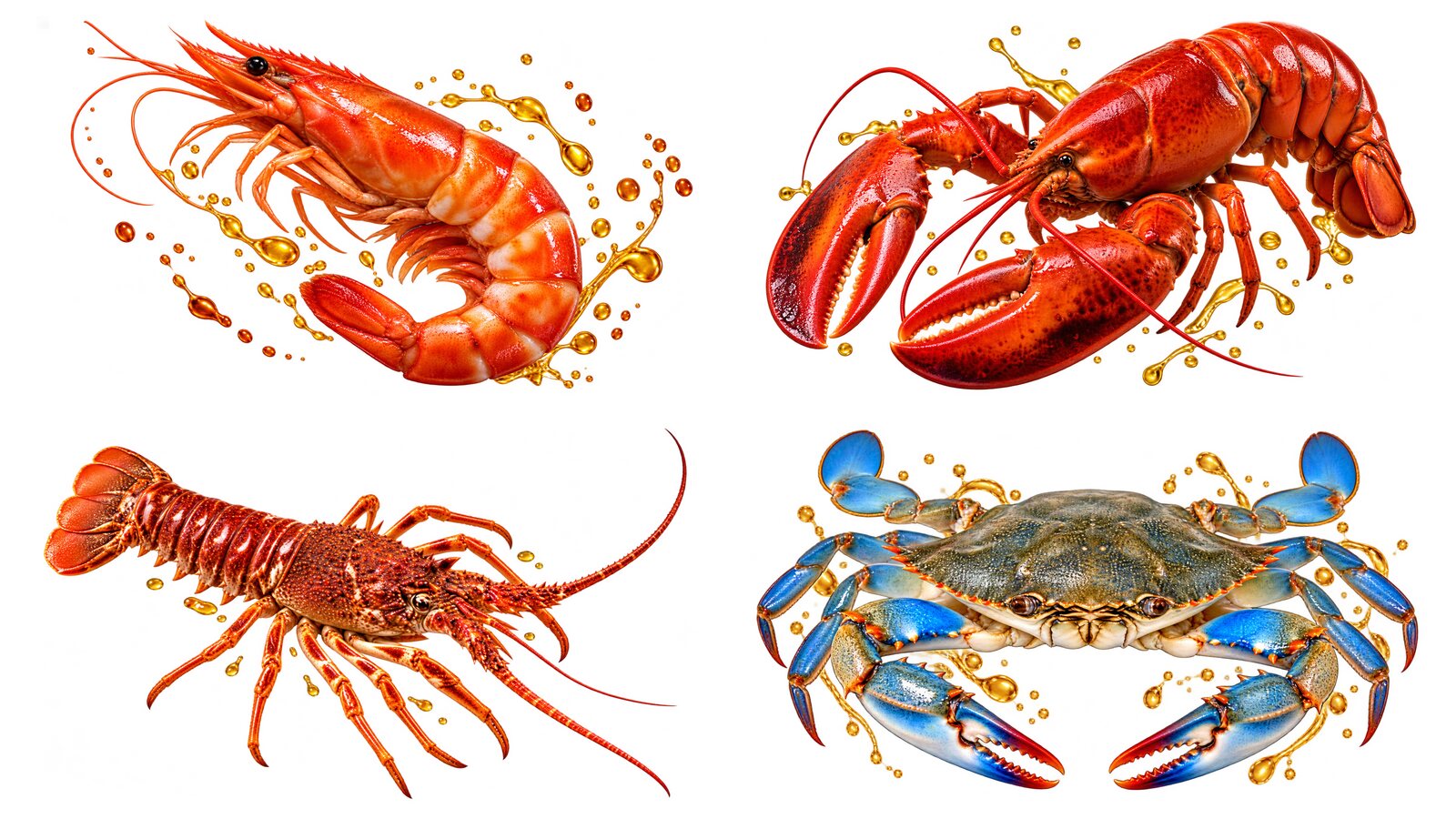
Shrimp, lobster, spiny lobster and crab extracts are concentrated ingredients based on real marine raw materials. They are excellent ingredients for achieving an authentic, characteristic shellfish profile in seafood products on an industrial scale.
The products come in an oil-based form, which makes them easy to dose into fat-containing systems and to distribute evenly throughout the recipe.
Why consider using them
- they build a flavour profile derived from a real marine raw material, not solely from an aroma composition,
- they allow precise dosing and standardisation of the sensory profile from batch to batch,
- they fit well into premium products in which lobster, spiny lobster, crab or shrimp is an important element of positioning,
- they can be used in a variety of matrices, from emulsions and oils to fillings, ready meals, surimi and stock bases.
01. Sensory profiles and recommended applications
The presentation covers four variants that differ in sensory character. This makes it possible to choose a concentrate not only according to the declared type of shellfish, but also to the desired intensity and style of the final product.
| Extract | Sensory profile | Particularly interesting applications |
|---|---|---|
| Shrimp | delicate, refined, marine | mayonnaise and sauces, pasta, ready meals, fillings, snacks |
| Lobster | intense, buttery, long-lasting | premium sauces, risotto, pasta, cream cheeses, ready meals |
| Spiny lobster | delicate, refined, complex | premium sauces, marinades, ravioli, delicatessen products, ready meals |
| Crab | fresh, subtle, aromatic | surimi, spreads, sauces, ready meals, snacks, stocks |
02. Key technological applications
- Marinades and flavoured oils: the concentrate can first be dispersed in oil and homogenised. The fat base becomes the carrier of the marine note and makes even dosing easier.
- Sauces and emulsions: in mayonnaise and pink sauces the concentrate can be added during mixing or homogenisation. This gives a uniform sensory profile throughout the mass.
- Ready meals: in rice, pasta and convenience dishes the extract can be added to the oil component or the sauce. The manufacturer’s materials also describe applying a thin layer of oil with the concentrate before the package is sealed.
- Fillings, spreads and cheeses: it can be dosed into cheese masses, ravioli fillings, spreads and creamy fillings. The fat phase helps distribute the shellfish profile evenly.
- Surimi and fish products: the concentrate can be added directly to the homogenised surimi mass; the product then goes through standard forming, cooking and cooling.
- Stocks and culinary bases: the presentation materials provide for use in stock cubes and Soffritto-type bases, where the concentrate delivers a recognisable, repeatable shellfish note.
03. Implementation tips for the food technologist
Choosing the dosage
The dosage level is a very individual matter that depends on the culinary effect you want to achieve, but a dose of just 5–6 ml of extract per portion already makes it possible to achieve something truly special in sensory terms. Doses should be set in technological trials separately for each matrix, with taste evaluation directly after production and after the declared storage period.
When to dose
In fat-based systems it is beneficial to disperse the concentrate in oil or the fat phase beforehand. In emulsions, uniform homogenisation must be ensured. In fillings and masses, the concentrate should be added at a stage that guarantees complete distribution.
Evaluation after processing
In products that are baked, cooked, pasteurised, frozen or reheated, sensory evaluation must be carried out after the complete process, because the aroma profile may change with temperature and the product matrix.
Product consistency
One of the practical benefits of the concentrate is the ability to standardise flavour through controlled dosing. However, any change in the base raw material, fat content or process requires the dosage to be validated again.
04. Quality and labelling aspects
- The extracts contain shellfish, so they require proper allergen management and appropriate labelling of the final product.
- The composition of the individual variants is not identical. Before implementation, work with the current specification of the specific extract.
- Some variants contain wine, cognac or components that may require additional labelling and tax assessment, depending on the alcohol content and the way the product is marketed.
- Marketing claims regarding naturalness, the type of raw material and the absence of artificial additives should be consistent with the manufacturer’s current documentation and the customer’s final recipe.
05. Technological conclusion
Shrimp, lobster, spiny lobster and crab extracts are an interesting tool for manufacturers looking for an authentic, culinary shellfish profile and the ability to control flavour intensity precisely. They are particularly well suited to premium products, sauces, ready meals, fillings, surimi, stocks and convenience solutions. Their implementation should include an application trial, sensory evaluation after the complete process and verification of the requirements concerning allergens and ingredient declarations.
Contact our expert
Looking for technological samples, technical specifications or an individual contract quote?
Mariusz Henzel – Sales Director
Mobile: +48 570 616 170
Landline: +48 (71) 388 93 50
Email: henzel.m@agrema.pl / agrema@agrema.pl
Website: www.agrema.pl